
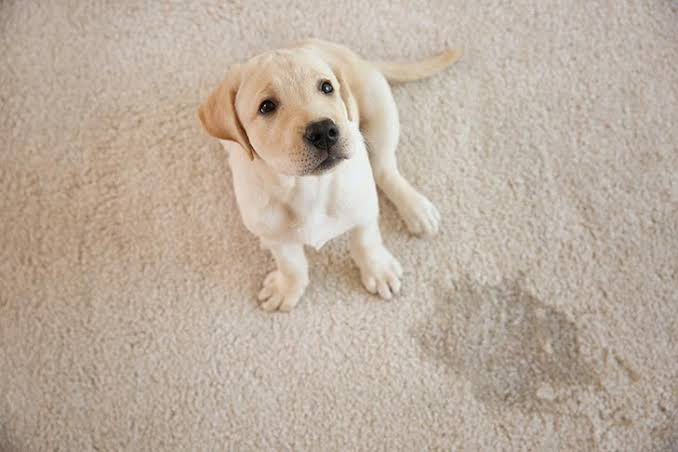
Let’s start with a couple important points:
1. Start potty training by creating a small enough space that your puppy doesn’t want to potty in their “den.” This is an instinctual behavior. This takes time and consistency, trial and error. Crate training at night can help teach them to alert you when they need attention. During the day, a playpen or small indoor fence can prevent them from wandering off and having accidents. I personally have had the most success with tether training, since limiting their freedom while they’re learning makes potty training much easier. It also helps with settling and bonding. However, tether training is what I consider an “advanced move” so be sure to do your research to avoid common mistakes that cause issues.
2. The second step is training yourself to recognize their cues and take them outside immediately. Remember, puppies are babies—they’re learning to control both their minds and bodies. Your puppy will be looking and listening for you constantly. You are their pack, their family, their everything. But let’s be honest – we as adults are horrible at staying present and in the moment. We are loosing the ability to build relationships between ourselves as human beings… and this is a whole other species we’re adding to the family. This will demand your full attention – or as much as you can spare – for quite a while.
Bringing an animal into your family is exciting—but it also comes with a learning curve. It’s easy to wonder, “How long is this going to take?” The following guidelines can help put the process into perspective: the 10-10-10 rule for potty training and the 3-day, 3-week, 3-month rule for animals settling into a new family.
Neither is a strict formula. Every animal is an individual. Instead, think of these as helpful frameworks for understanding what your new companion may be experiencing and how you can support them.
The 10-10-10 Rule for Potty Training
Potty training is all about helping your animal understand where and when it’s appropriate to go. One useful way to structure your routine is the 10-10-10 approach:
10 minutes or less after eating or drinking
After a meal or a good drink of water, give your animal an opportunity to go potty about 10 minutes later.
Young animals often have fairly predictable bathroom needs, and meals can stimulate their digestive system. Taking them out proactively can help prevent accidents and create a successful habit.
10 minutes or less after waking or playing
Sleep and activity are two major potty triggers.
Take your animal outside or to their designated potty area shortly after they wake up. Likewise, after a period of energetic play, offer another potty break.
The goal isn’t to wait for an accident. It’s to get ahead of the need.
10 opportunities to succeed
The final “10” is about repetition. Give your animal frequent opportunities to get it right, especially during the early stages of training.
Every successful trip is a chance to reinforce the behavior you want.
When they potty in the appropriate place, calmly praise them and provide positive reinforcement. Over time, your animal begins to make the connection:
“This is where I’m supposed to go.”
Remember: the clock isn’t magic
The 10-10-10 concept should be treated as a starting point, not a stopwatch. A very young puppy may need to go out much more frequently than an older dog. Individual animals, feeding schedules, medical conditions, activity levels, and household routines all matter.
If your animal suddenly begins having accidents after previously being reliably house-trained, it’s worth talking with your veterinarian to rule out an underlying medical issue.
Katie’s Favorite Potty Training Tools: Bells and Talking Buttons
Teaching a dog to potty using bells or a talking button can be a simple way to help them communicate when they need to go outside. Start by associating the bell or button with opening the door and potty trips, then reward your dog immediately whenever they use it before going outside. This can be a little tricky at first, but once your puppy gets the hang of it—and gets over the realization of, “OMG, I can make my family do things for me! Let’s play!”—it’s amazing how handy this communication can be. It becomes a lifelong signal and there is rarely any confusion about what exactly your dog needs and very few accidents because they can get your attention even when you are distracted. With consistency and patience, teaching your puppy to use a bell or talking button to signal potty time can make life so much easier! With consistent practice, praise, and treats, your dog can learn that ringing the bell or pressing the button is a way to ask for a bathroom break.
The “Alpha” Dog Myth & Puppy Potty Training
Dogs naturally prefer to keep their sleeping and living space clean, so your job is to make it clear where their “den” is and where they should go potty. Never punish your dog by rubbing their nose in a mess or spanking them. Physical punishment only creates fear and confusion; it does not teach them what you want them to do. When they have an accident, they are not disrespecting you or your home. They are simply babies.
If you catch your puppy having an accident, a calm but firm “No” can interrupt the behavior, followed immediately by taking them to the appropriate potty spot. Timing is important because puppies have a very limited ability to connect a correction with something that happened several seconds ago. If you discover a mess after the fact, simply clean it up and focus on preventing the next accident rather than punishing the puppy.
Above all, remember that your dog will learn to trust and respect you through fairness, consistency, patience, and clear communication—not through fear or dominance. Your goal is not simply to stop unwanted behavior, but to teach your dog what you want them to do and give them the opportunity to succeed.
The old “alpha” philosophy came largely from early studies of wolves kept in captivity, where unrelated wolves were placed together in unnatural conditions and observed competing for resources. The researcher behind that work later acknowledged that the model did not accurately describe how wolves behave in natural family groups.
In the wild, wolves and other canines generally live in family groups, with cooperation, communication, boundaries, and relationships playing important roles. A healthy relationship with your dog doesn’t require you to “be the alpha” or constantly prove that you are in charge. You can set boundaries, teach good manners, and provide structure without intimidation or fear. Your dog doesn’t need to be dominated—they need to understand what you’re asking, know what is expected of them, and feel safe enough to trust you. Fairness, consistency, patience, and positive reinforcement create a much stronger foundation for a lifelong relationship than trying to overpower your dog.
The 3-Day, 3-Week, 3-Month Rule
Potty training isn’t the only adjustment happening when an animal joins a new family.
Imagine being taken from everything familiar—your people, smells, routines, surroundings—and placed somewhere completely new. Even a confident animal may need time to understand that this new place is home.
That’s where the 3-day, 3-week, 3-month rule can be helpful.
The first 3 days: “Where am I?”
During the first few days, your new animal may simply be trying to figure things out.
They may be:
- Nervous, quiet, or withdrawn
- Overexcited or unusually energetic
- Unsure about eating or drinking
- Having potty accidents
- Hiding or seeking constant attention
- Sleeping more than expected
- Exploring every corner of the house
Some animals appear immediately comfortable, while others need more time.
Try to keep these first days calm and predictable. Establish simple routines for meals, potty breaks, sleep, play, and quiet time.
Don’t worry if your new companion doesn’t seem like “themselves” yet.
They’re still figuring out what this new life means.
The first 3 weeks: “I’m learning the routine.”
After a few weeks, many animals begin to understand the household rhythm.
They learn:
This is where I eat.
This is where I sleep.
These are my people.
This is when we go outside.
These are the sounds and routines of our home.
You may begin seeing more of their personality during this stage. They might become more playful, affectionate, confident, or independent.
You may also see behaviors that weren’t obvious during the first few days.
That’s not necessarily a setback. It can actually mean your animal is becoming comfortable enough to show you who they really are.
Continue reinforcing desired behaviors and maintaining consistent boundaries.
The first 3 months: “This is home.”
Around three months, many newly adopted animals have had substantially more time to settle into their environment and build trust.
Their routines are familiar. Their people are familiar. Their surroundings smell like home.
This is often when the relationship can really begin to deepen.
But remember: three months isn’t a deadline.
Some animals settle in much faster. Others—particularly animals who have experienced major changes, neglect, fear, or repeated transitions—may need considerably longer.
Progress isn’t always linear.
What These Two Rules Have in Common
At first glance, potty training and settling into a new family may seem like completely different challenges.
But they’re built on many of the same principles:
Consistency
Animals learn through repetition. Predictable routines make it easier for them to understand what is expected.
Patience
Accidents, nervous behavior, and setbacks are part of the learning process. Getting frustrated doesn’t make an animal understand faster.
Positive reinforcement
Notice and reward the behaviors you want to see. Help your animal understand what works rather than focusing only on what went wrong.
Predictability
Regular meals, potty breaks, walks, playtime, and bedtime can help a new animal feel secure.
Trust
A relationship takes time. Your animal doesn’t automatically know that your home is safe, that you’re going to care for them, or that they belong.
You get to show them.
One meal, one walk, one successful potty break, and one peaceful day at a time.
Give Them Time to Become Themselves
One of the easiest mistakes new pet parents can make is expecting an animal to immediately behave the way they will once they’re fully comfortable.
A newly adopted dog who hides behind the couch may eventually become the dog who follows you everywhere.
A nervous puppy who has accidents may eventually wait patiently at the door.
A quiet cat may eventually sprawl across the middle of your bed as though they’ve always owned it.
The transformation doesn’t happen overnight.
You’re not just training an animal. You’re building a relationship.
The 10-10-10 rule can help you create opportunities for potty-training success. The 3-day, 3-week, 3-month rule can remind you that settling into a new family is a process.
Together, they offer a simple message:
Give them structure. Give them consistency. Give them patience. And, most importantly, give them time.
Because sometimes the biggest milestone isn’t the first accident-free week or the first command they master.
It’s the day they finally look around your home and realize:
“I’m safe. I’m loved. I’m home.”