
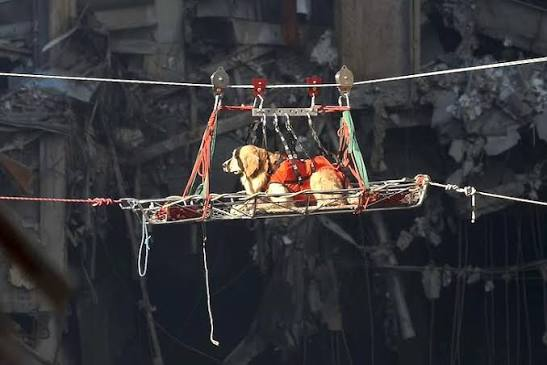
Ground Zero: The Guiding Light and the Ground Searchers
In the chaos of September 11, 2001, when the world seemed to be tearing apart, Labradors were there to bring order, safety, and comfort to New York City.
Roselle: The Guide Dog Who Defied the Chaos
On the morning of 9/11, Michael Hingson was working on the 78th floor of the North Tower when the first plane struck. Beside him was Roselle, his yellow Labrador guide dog. As smoke began to fill the building and panic swelled around them, Roselle remained perfectly calm.
With debris falling and the building swaying, Roselle focused entirely on her handler. She safely guided Michael and a crowd of terrified office workers down 1,463 steps to the street. Even when the South Tower collapsed nearby, blinding them with ash and debris, Roselle never panicked. She walked Michael through the suffocating dust to safety, proving that a Lab’s devotion knows no bounds.

Salty: A Companion’s Refusal to Leave
Much like Roselle, a yellow Labrador guide dog named Salty was on the 71st floor of the North Tower with his owner, Omar Eduardo Rivera. When the plane hit, the skyscraper shook violently, and the stairwells filled with choking smoke. Rivera, realizing the immense danger, unclipped Salty’s leash, urging the dog to run ahead and save himself. Salty refused. He pressed against Rivera’s leg, insisting they navigate the treacherous, crowded exit together. Alongside a coworker, Salty calmly guided Rivera down more than 70 flights of stairs. Just over an hour later, they reached the street—only moments before the tower collapsed. For his fierce, unshakeable loyalty, Salty was co-awarded the prestigious Dickin Medal alongside NYPD K9 Apollo.

Jake: Finding Hope in the Rubble
While guide dogs led survivors out, other Labs rushed into the wreckage. Jake, a resilient black Labrador who had been adopted as a stray with a broken leg, arrived in New York as a member of Utah Task Force 1.
Jake spent 17 grueling days navigating the burning, jagged mountain of debris known as “The Pile.” Working 12-hour shifts, his nose detected scents buried deep beneath the steel. When the weight of finding so few survivors began to take a psychological toll on the dogs, handlers staged “mock finds” to keep Jake’s spirits up. His relentless work ethic and joyful spirit brought a sliver of comfort to exhausted human first responders who desperately needed a reason to keep going.
Iraq and Afghanistan: Guardians of the Frontlines
In the conflicts following 9/11, the U.S. military—especially the Marines—began relying heavily on purebred Labrador Retrievers. Chosen for their unparalleled sense of smell and non-aggressive temperaments, these Labs took on the lethal threat of Improvised Explosive Devices (IEDs).

Eli: A Bond Unbroken by Battle
In Iraq, a black Labrador named Eli was partnered with Marine Lance Cpl. Colton Rusk. The two became inseparable, with Eli sleeping at the foot of Colton’s cot every night and leading the way on dangerous patrols by day.
Tragically, in 2010, Colton was killed by enemy fire in Afghanistan. After his death, Eli refused to leave the side of Colton’s body. Recognizing the profound bond between the Marine and his dog, the military granted Eli an early retirement. In a deeply moving ceremony, Eli was adopted by Colton’s grieving family in Texas. There, Eli provided the ultimate form of service: helping a Gold Star family heal, carrying the memory of his handler forward with every wag of his tail.

Blue: A Nose for Danger
In Afghanistan, a black Labrador named Blue served alongside Marine Cpl. Byung “BK” Kang as an improvised explosive device detection dog. During their deployment in 2011–2012, Blue and Kang went on more than 300 combat missions, searching for hidden explosives that could kill or seriously injure the Marines and sailors behind them. Blue proved her ability almost immediately, detecting an IED on their very first mission and going on to find many more. Her alert was simple but lifesaving: when she detected the scent of explosives, she would lie down and wait for her handler. Years after their deployment ended, Kang never forgot his partner. He eventually tracked Blue down and adopted her after her retirement, giving the brave dog who had protected so many others a safe and loving home for the rest of her life.

Coffee: Three Tours of Valor
An extraordinary chocolate Labrador named Coffee proved just how resilient the breed can be. Serving with the U.S. Army for over 10 years, Coffee completed three separate, high-risk deployments to Afghanistan as an specialized bomb-detection dog.
Throughout her long military career, Coffee repeatedly alerted her squad to buried roadside IEDs before they could detonate. Walking point on dangerous dirt tracks, her steady, calm demeanor kept her platoon grounded during high-stress patrols. Throughout his grueling deployments in active combat zones, Coffee successfully detected numerous hidden explosives and never lost a single soldier under his watch. Coffee retired a decorated hero, receiving the American Humane K9 Medal of Courage—the nation’s highest honor for military working dogs. SFC Bennett adopted Coffee when she retired and welcomed her into his family, including his wife, Lindsay, and their three children.
Zeke: Shifting the Battle Against Trauma
Not all battles in war zones are fought with weapons; many are fought within the mind. In 2011, a five-year-old yellow Labrador named Zeke deployed to the Kandahar military base in southern Afghanistan. Zeke was no ordinary military dog—he held the rank of Sergeant First Class and served as a combat stress-control therapy dog.
Stationed at a medical clinic, Zeke’s mission was to help soldiers cope with severe war trauma, grief, and operational stress. In an environment of constant tension, a few minutes petting Zeke, feeling his heavy head rest on their knees, or playing a quiet game of fetch allowed heavily burdened soldiers to feel a piece of home. Zeke healed the invisible wounds of war, proving that a Lab’s empathy is just as powerful as a bomb-detection nose.
A Personal Note
This is a difficult blog to write. As active-duty U.S. Army veterans who served in Iraq and Afghanistan, my husband and I have been profoundly affected by the history and legacy of 9/11. We were both injured while serving and have experienced firsthand the ways service dogs can help us navigate both physical challenges and PTSD.
I consider myself fortunate to give something positive back to the animals that have given so much to us. Their playfulness, loyalty, and compassion have brought meaning and purpose back into my life at times when I wasn’t sure I would find either again after my military service.
There are so many other dogs I would like to include—dogs whose stories I know not only from research, but from personal experience. There was the German Shepherd who took a bullet protecting us from small-arms fire while we were on gate duty at Camp Marmal in Mazar-i-Sharif, Afghanistan. The Golden Retriever therapy and emotional-support dog who spent time with us in Bagram and brought comfort during an incredibly difficult period.

And then there was Vino, the black Labrador Retriever my husband brought home for me after we returned from deployment in 2012. At the time, I was struggling so deeply that I couldn’t get out of bed. Vino was eventually trained by Paws for a Cause as my service dog, providing physical stability and assistance. But before he ever performed a trained task, he gave me something I desperately needed: a reason to look forward to life again.
I remember the little things. Vino barking at me to join him in the sunshine when he went outside to go to the bathroom as a puppy – again. For the 124th time that day. Vino spent way too much time in bed with me as a puppy, but he just looked at me with his soulful eyes and I knew he understood. His antics at mealtimes were ridiculous, especially if I was dragging my feet. And holy *expletive* did he LOVE a BALL. He would chase a ball until I forced him to stop – he was insatiable! The moments that made me laugh when I wasn’t sure I could laugh anymore. Sometimes healing begins with something as simple as a dog making you smile.

A few years later, we brought Sky into our family as a PTSD therapy dog. She was a Lab with the softest, palest yellow coat I’ve ever seen. Sky was one of the gentlest souls I have ever known of any species. Somehow, Sky seemed to understand the people around her—to sense when someone was hurting and quietly offered exactly the comfort they needed. She was a quiet-hearted, peaceful lady whose favorite pastime was sitting outside on the porch watching the neighbors cows.
Vino and Sky passed away not long ago, within a year of one another. Losing them was heartbreaking, but their impact on my life will never disappear. They helped me find my way forward, and they inspired me to begin breeding Labrador Retrievers and working with other veterans who need that lifeline.
That is why I write about these dogs. They aren’t simply stories about remarkable animals. They are part of my story, too—and a reminder of the extraordinary bond between those who serve and the dogs who stand beside them.
